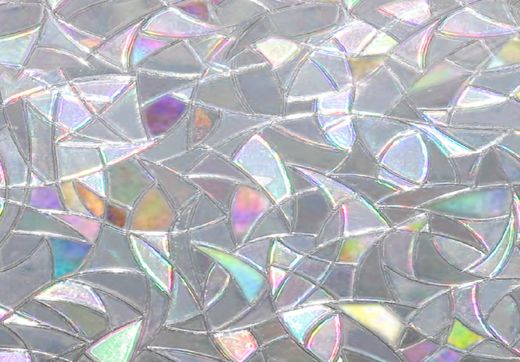
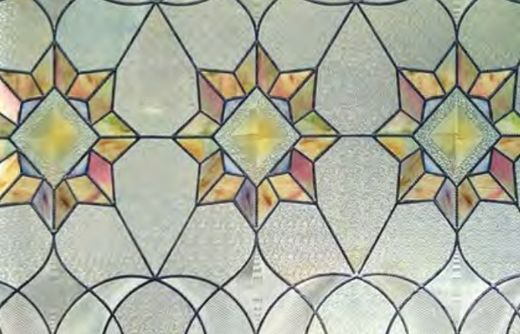
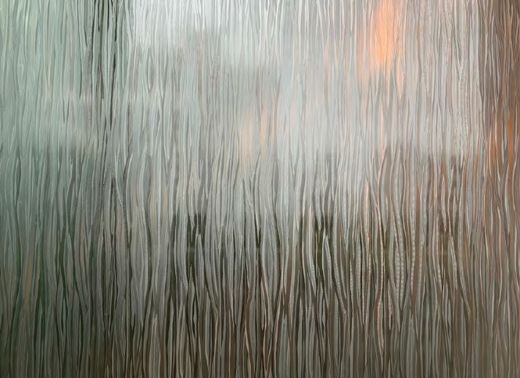
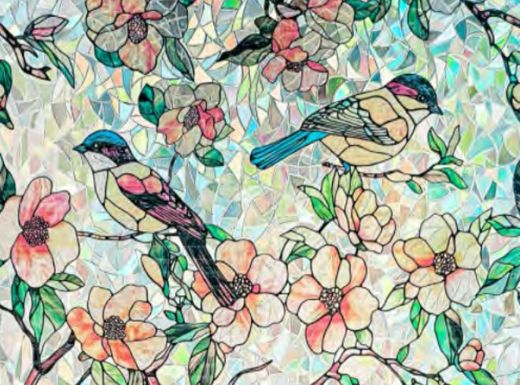
Wood-framed kitchen window covered in white-lily stained glass window film

Window film · cut to size · Chicagoland

Change the glass. Keep the light.

Stained glass, frosted privacy, one-way storefront graphics and solar film. Cut to your exact window, shipped ready to install, or installed by us across Chicagoland.

280+designs to order
85%solar heat rejected, best solar film
99%UV blocked by adhesive solar film
59.8″widest roll, any length
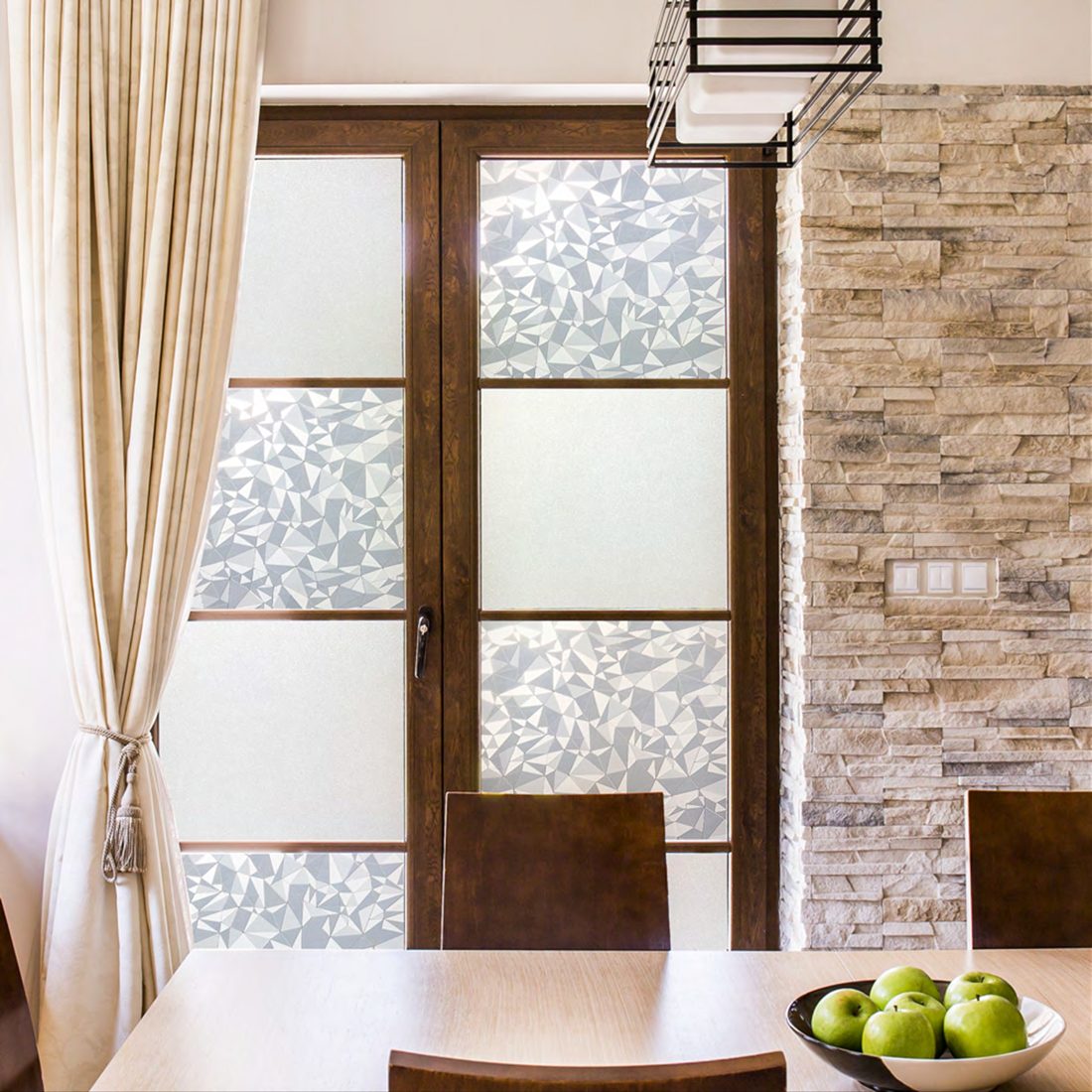
Dining room glass doors with frosted and faceted privacy film on alternate panes

For homes

Privacy that lets the daylight in.

Curtains give you privacy by taking away the light. Film does the opposite. Frosted, textured and stained-glass films blur the view from outside while the room stays bright, and they keep working after dark, when blinds usually stay open by mistake.

  • Bathrooms, front doors, sidelights and street-facing bedrooms
  • Cut to each pane, so the pattern lines up across the window
  • Up in an afternoon with water and a squeegee

For storefronts & offices

Turn the glass into your best sign.

Your windows are the biggest ad space you already pay for. One-way perforated graphics print full color on the street side while staff inside see straight out. Frosted film with your logo brands a lobby or conference room, and solar film stops the window display from fading.

  • Printed in our own shop, with a proof before anything is cut
  • Measured and installed across Chicagoland
  • Anti-graffiti and safety film for street-level glass
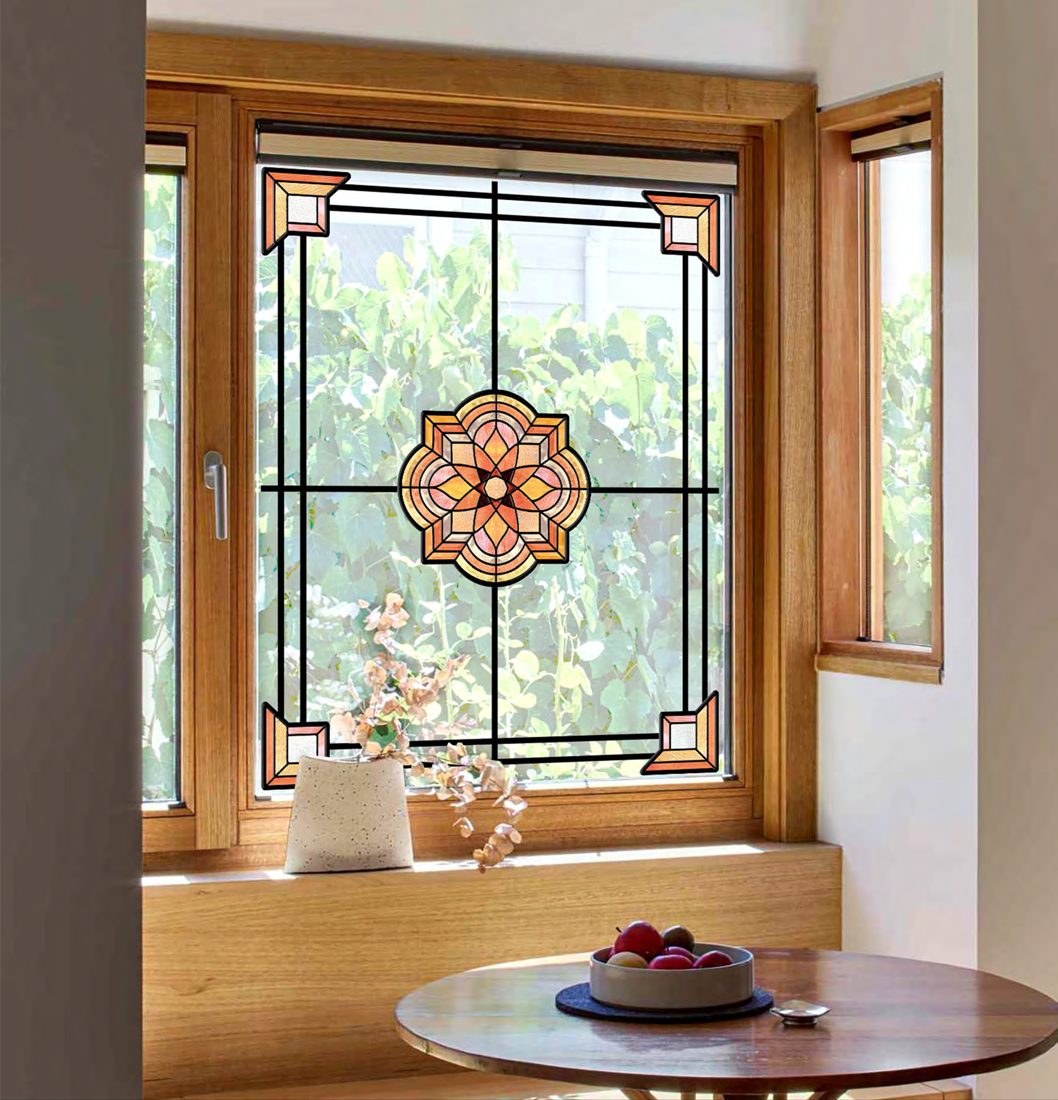
Kitchen window with a stained-glass style corner and medallion window sticker

For renters

Change the look. Leave no trace.

Static cling film holds to glass with no glue at all. It goes up wet, peels off clean at move-out, and can be rolled up and reused in your next place. Your landlord never needs to know, and your deposit stays yours.

  • No adhesive, no residue, reusable
  • Stained glass medallions and corners for a quick upgrade
  • Works on smooth, flat glass

01 · Perforated window vinyl

A billboard outside. A clear view inside.

Perf is vinyl punched with thousands of tiny holes. Your graphic prints on the outside face. The black backing inside lets the eye look straight through the holes, so the room keeps its daylight and its view of the street.

Full-color graphic, holes barely visible

Example storefront. Tap "From inside" to see the view your staff keeps.

70/30Shown about 6× actual size

70% printed vinyl, 30% open holes. The richest color and the boldest graphic. The pick for storefronts and building glass.

50/50Shown about 6× actual size

Half print, half holes. The clearest view out, at the cost of some color. The usual choice for vehicle rear windows, and legal on Illinois rear glass when the vehicle has a mirror on each side.

  • Storefront windowsHours, promos, brand walls, "coming soon" for build-outs
    $16/sq ft
  • Vehicle rear windowsPre-sized panels for SUVs, vans and pickups
    from $149
  • Office & lobby glassBrand the glass without losing the light
    $16/sq ft
  • Schools & gymsMascots and team graphics, privacy for ground-floor rooms
    $16/sq ft
  • Vacant units & constructionLeasing graphics that hide the work behind them
    $16/sq ft
Material
Perforated vinyl with black adhesive backing
Laminate
Optically clear, so rain doesn't fill the holes and blur the view
Outdoor life
Printed perf is rated for about a year outdoors. Most shops change storefront graphics before then anyway.
At night
View reverses when the inside is lit and the street is dark

02 · Privacy & decorative film

Pick a film. See it in the window.

Bathrooms, front doors, conference rooms, waiting rooms. Tap any film to put it in the window, then switch to evening to see how it reads with less light behind it.

Your logo, etched in frost

Frosted film printed with your logo, an eye-level privacy band for a conference room, or the dot strip glass doors need so nobody walks into them. Printed in-house.

Send artwork

Compare before you buy

What each film does, day and night.

Most listings stop at "privacy film." These are the manufacturer's measured figures for the stock builds, so you can pick by the problem you actually have.

FilmSolar heat rejectedUV blockedPrivate after dark?Best for
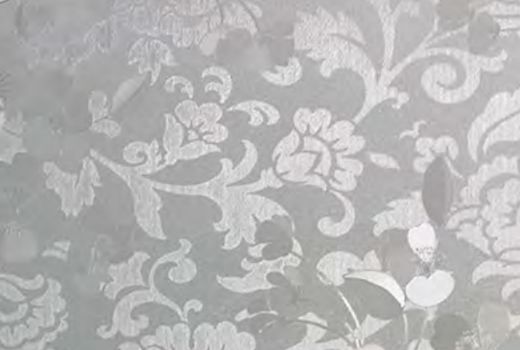
White matte frosted86%99%YesBathrooms, street-facing bedrooms
Classic frosted76%90%YesFront doors, offices, sidelights
Blinds-pattern film57%87%YesLooks like blinds, nothing to dust
Brushed silver55%78%YesModern offices, partitions
Opaque reeded glass47%82%YesShower glass, reeded-glass look
One-way mirrorSee solar films belowNo, reverses at nightDaytime privacy with a view out
Opaque blackout100%100%Yes, blocks all lightDay sleepers, storerooms, displays

Manufacturer-rated figures for stock builds. Stained-glass and printed films pass color and light; the denser the design, the more they hide.

Static clingNo glue at all

Holds by static on smooth, flat glass. Peels off clean and goes back up. The pick for renters. It won't grip frosted, sandblasted or textured glass.

Low-tackStays put, leaves clean

A light adhesive that comes off without damage at the end of a lease. Good for larger panes that static would let slip.

PermanentFor the long haul

A full adhesive bond for busy commercial glass and anything that gets cleaned hard and often.

Roll widths

17.7″23.6″35.4″47.2″59.8″ solar & safety

Any length, cut to your window. Wider panes get a seamed install or a wider solar roll.

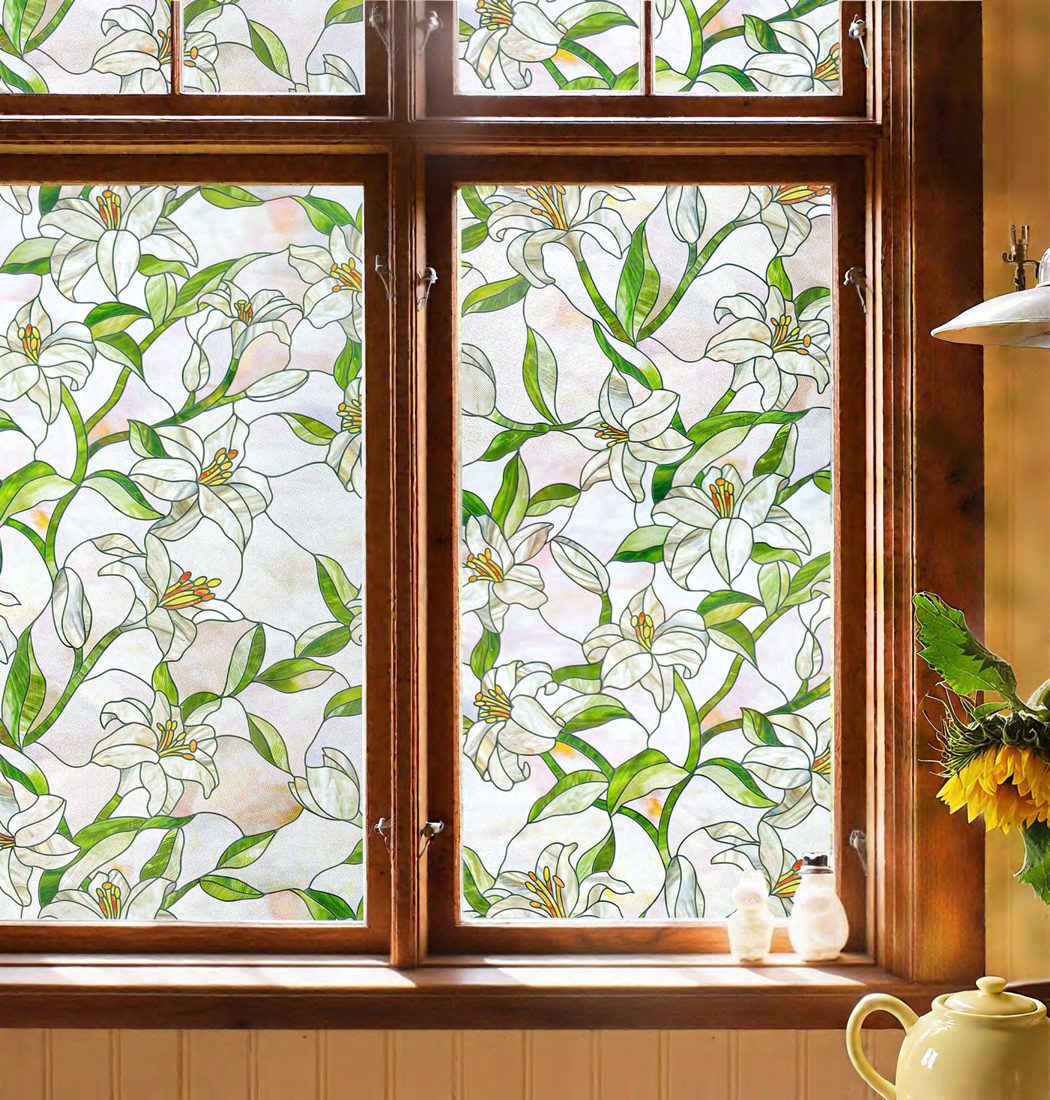
Kitchen window covered in white-lily stained glass film
Leaded-glass looks. No lead, no kiln, no glazier.

Stained-glass film goes up in an afternoon with water and a squeegee, and comes off when you move.

03 · Solar & protective film

Keep the sun. Lose the heat.

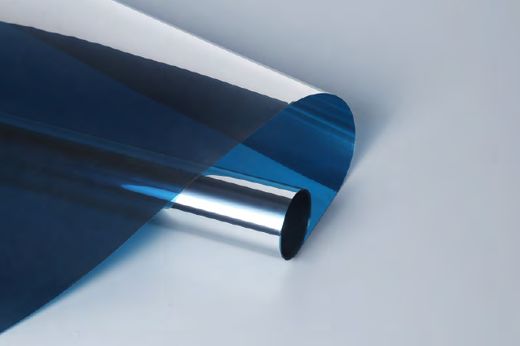
Reflective film for west-facing rooms, home offices with screen glare, and shop windows where the merchandise keeps fading.

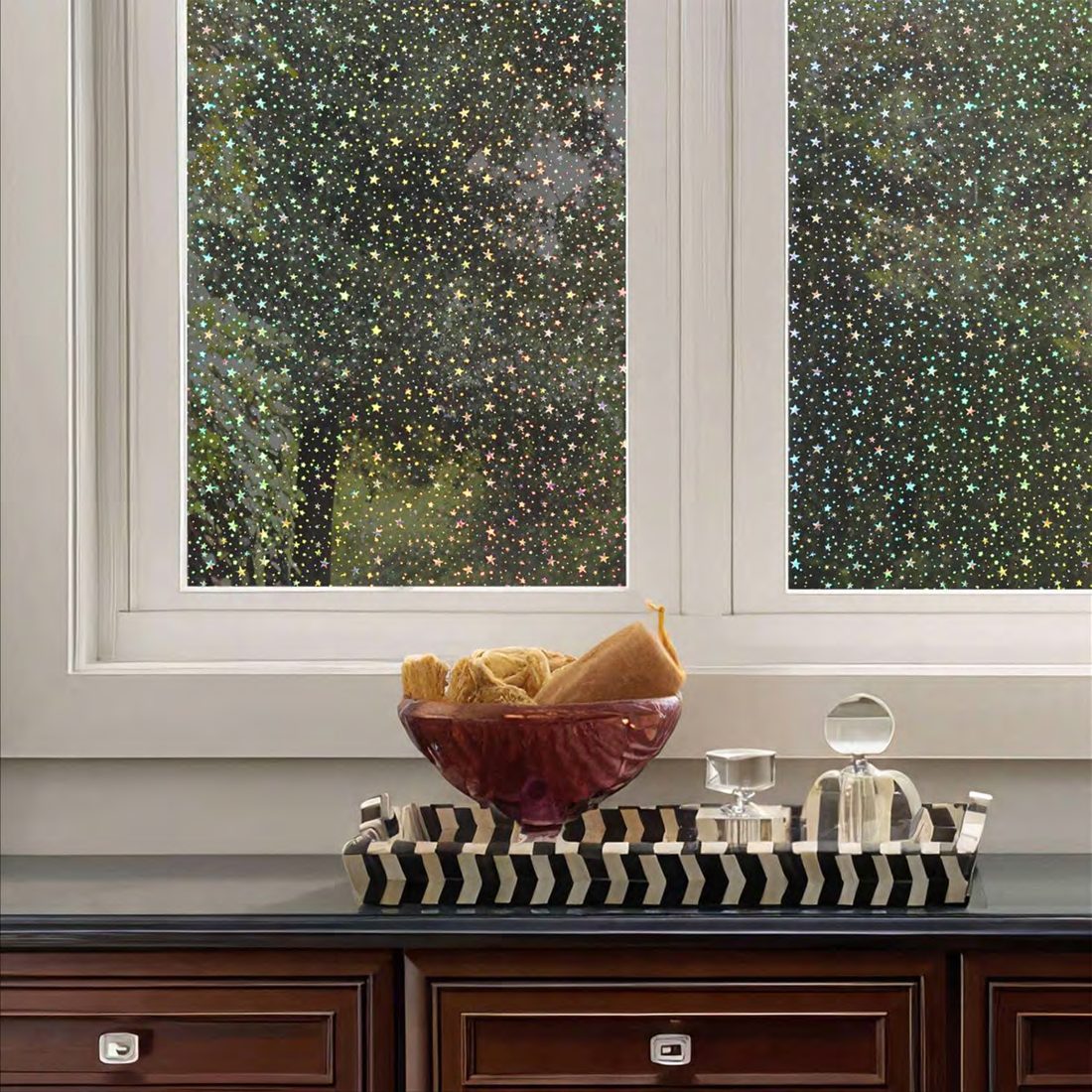
Kitchen window with dark starry solar film

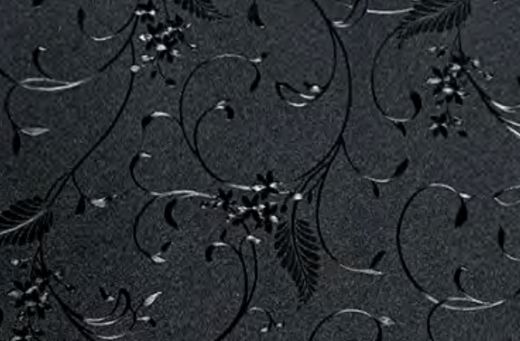
Starry solar film. Mirror outside, a night sky inside.

Adhesive solar · 5 shadesThe heat cutter
44–85%heat rejected99%UV blocked

Thin 2.8 mil PET. Brown-silver and double-sided silver reject the most heat; gray-blue cuts the most glare.

Static cling solar · 4 shadesNo-glue, removable
79–82%heat rejected72–90%UV blocked

Silver-based shades that go up and come down with water. Ideal for rentals and seasonal rooms.

PhotochromicClear until the sun hits
85%glare cut97%UV blocked

Starts clear and darkens in direct sun. Chosen for glare and UV, not heat (16–30%).

One-way mirrorDaytime privacy
Mirroroutside by dayClearview out

Reflective while it's brighter outside. After dark with lights on, the effect reverses.

Pick by the complaint. Too hot? Go for heat rejection. Can't see the screen? Go for glare reduction. The darkest shade isn't automatically best at both.

Finishes

Before we quote solar: dark, heat-absorbing film can crack annealed glass, very large panes, glass that's partly shaded, or panes with chipped edges. We ask for your glass type and size first. Solar film is for home and building glass, not car windows. And reflective film cuts summer heat but doesn't insulate against winter cold.

Safety film, clear or reeded

A 4 mil polyester layer bonded to the glass. When the pane breaks, the pieces stay stuck to the film instead of falling. The reeded version adds privacy in the same layer. It makes glass safer, not unbreakable.

Anti-graffiti film

A clear sacrificial layer for storefronts and transit glass. When it gets scratched or tagged, peel it and replace it instead of the glass.

How an order runs

From tape measure to finished glass.

Home orders ship cut to size. Commercial jobs around Chicago get a site visit and installation.

  1. i.Measure

    Width × height of the visible glass inside the frame, to the nearest 1/16 inch. Every pane.

  2. ii.Choose

    Pick a film, or get a sample pack and hold it against your own window first.

  3. iii.We cut & print

    Every piece is cut to your sizes. Perf and logo film print in our shop.

  4. iv.Install

    Spray, place, squeegee, trim. Or book our installers anywhere in Chicagoland.

Pricing

Clear prices, by the square foot.

Measure the glass, multiply width by height in inches, divide by 144, and you have square feet. Or let the calculator in the quote form do it. Prices are per square foot of glass covered.

FilmCut to size, you installInstalled by usNotes
Stained glass, frosted, prismatic, printed & blackout$11 / sq ft$14 / sq ftStatic cling or adhesive, same price
Frosted film with your logo$18 / sq ft$23 / sq ftIncludes a proof before printing
Solar & mirror film$9 / sq ft$15 / sq ftWe check your glass type first
Safety & anti-graffiti film–$16 / sq ftInstalled only, so it's bonded right
Storefront perf, printed & laminated$16 / sq ft$21 / sq ft70/30 or 50/50
Vehicle rear window perffrom $149from $199SUVs, vans and pickups
Sample pack, 5 films$12Credited back on your first order
Minimums$45 shipped, $275 installed

Shipped orders have a $45 minimum. Installed jobs have a $275 minimum, which covers a front door or a small bathroom window.

Trip chargeFree within 30 miles

Jobs within 30 miles of Addison have no trip charge. From 31 to 75 miles it's $95. From 76 to 300 miles it's $1.75 per mile each way, quoted up front.

ShippingCut, rolled, boxed

Cut-to-size orders ship rolled in a tube with install instructions. Shipping is calculated at checkout.

Removing old film, ladders over 12 feet, after-hours storefront installs and custom design work are quoted separately.

Quote & samples

Send your sizes. Get a price the same day.

Type in the glass size and the square footage works itself out. Still deciding on a pattern? Start with samples.

Sample pack, 5 films

$12, credited back on your first order

24.0 sq ft
2 panes × 36″ × 48″
$288
Estimate, cut to size

The window film guide

Everything we'd tell you over the counter.

Which film goes in which room, how to put it up without bubbles, how to get it off again, and what the spec-sheet words actually mean. Written by people who cut and install film every week.

Which film for which room

Start with the problem, not the pattern. A bathroom needs privacy at night. A home office needs less glare at 3 pm. A storefront needs to sell. The same film rarely solves all three.

Bathroom
White matte frosted or a textured film. Both stay private after dark, which a mirror film won't. On a shower window, go adhesive: steam and splashes loosen static cling over time.
Front door & sidelights
Stained glass or a frosted pattern. Sidelights are where neighbors and delivery drivers look in, and a leaded-glass design makes an entry look custom without a glazier.
Bedroom
Frosted film for privacy with daylight, or opaque blackout for night-shift workers and nurseries that nap during the day. Blackout can go on the bottom half only, so the top still lets light in.
Kitchen
Prismatic or a light stained-glass design over the sink. Kitchens usually face the backyard, so the goal is decoration and a little screening, not full privacy.
Home office
Glare is the problem here. A gray-blue solar shade or photochromic film keeps the screen readable without darkening the room at noon in winter.
Basement & garage
Textured or reeded film hides storage and gym equipment from the street while keeping the space bright.
Conference room
A frosted band at seated and standing eye level, roughly 30″ to 66″ from the floor, often with your logo cut in. Glass walls also need visible markings so nobody walks into them.
Clinics & therapy offices
Full-height frosted or textured film on exam and session room glass. Privacy is not optional there, and film is far cheaper than replacing glass with obscure glass.
Restaurants & salons
Perf or a printed frosted band on street glass. Diners and clients get privacy at table height, and the window still advertises the business to the sidewalk.
Storefronts
One-way perforated graphics for promotion, solar film where merchandise fades in the window, or both. Perf goes on the outside face; most solar film goes on the inside.

How to install window film

Nearly every film goes up the same way, wet. The water lets you slide the film into place before you squeegee it down. Plan on 15 to 30 minutes for a normal window once you've done one.

What you need

  • A spray bottle of water with a few drops of baby shampoo or dish soap
  • A plastic squeegee or a felt-edged card
  • A sharp utility knife with fresh blades and a straight edge
  • Lint-free cloths and a razor scraper for the glass

Step by step

  1. Clean the glass twice. Scrape off paint flecks and old residue with the razor, wash with soapy water, then squeegee it dry. Any speck left behind becomes a bump under the film.
  2. Cut the film a little oversize. Leave about an inch extra on each side. You'll trim it on the glass for a perfect edge.
  3. Soak the glass. Spray the window until it runs. Don't be shy with the water.
  4. Peel and spray the film. Remove the backing liner while spraying the exposed side, so dust and fingerprints don't stick to it.
  5. Place and slide. Lay the wet side on the wet glass and slide it until the pattern lines up. Spray the outside face so the squeegee glides.
  6. Squeegee from the center out. Push water and air toward the edges in overlapping strokes. Work slowly; this is where the clarity comes from.
  7. Trim the edges. Run the knife along a straight edge, leaving a 1/16″ gap to the frame so water can escape and the film doesn't lift.
  8. Squeegee once more and leave it. Small hazy spots of trapped water disappear on their own as the film cures, usually within a few days, longer in cold weather.

Static cling is ready the moment it's down. Adhesive film needs time to cure, so don't wash it for about a month. Perf and large storefront panes are easier with two people or an installer.

Cleaning, care and removal

Once it's cured, clean film like you'd clean the glass, only gentler. Use mild soapy water or an ammonia-free glass cleaner, a soft cloth or rubber squeegee, and nothing abrasive. Skip paper towels and scrub pads, which scratch the surface over time.

Removing static cling: lift a corner with a fingernail and peel. Roll it onto its original liner or a sheet of wax paper if you want to reuse it next season.

Removing adhesive film: warm it with a hair dryer or the sun, peel slowly at a low angle, then soak any leftover adhesive with soapy water and take it off with a razor scraper held flat. Scrape glass only, never a coated or low-E surface.

Renting? Static cling and low-tack films are made for you. They come off clean at move-out, and nothing about your window changes.

Stained glass styles, explained

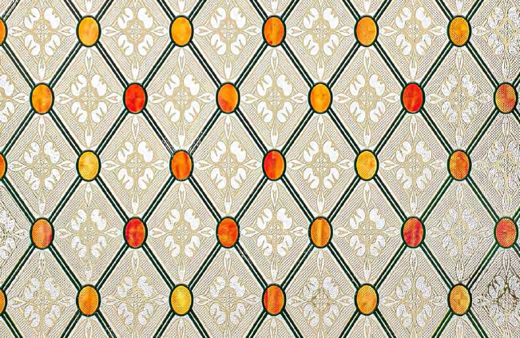
Stained glass film reproduces the look of colored glass held together by dark lead lines, called "came." The style you pick should follow the age and architecture of the house.

Victorian
Busy, symmetrical, jewel-toned. Diamonds, fleur-de-lis, and borders around a clear center. At home in Chicago greystones and Victorian two-flats.
Gothic & church
Pointed arches, tracery and deep reds and blues. Right for arched windows and stairwell landings.
Art Deco
Fans, sunbursts and stepped geometry in amber and smoky tones. Suits 1920s bungalows and vintage apartment buildings.
Art Nouveau & Tiffany-style floral
Flowing stems, lilies, irises and magnolias with painterly color. The most popular look for kitchens and bathrooms.
Leaded & beveled
Mostly clear or textured glass in a lead grid with few colors. Elegant and calm, and it lets the most light through.
Prairie
Straight lines, rectangles and earth tones, in the spirit of Chicago's Prairie School houses. A natural fit for bungalows in Oak Park and the western suburbs.
Modern
Abstract shapes, bold color fields and soft gradients. For new builds and condos that want color without the antique feel.

Designing a graphic for perforated film

Perf prints through thousands of holes, so it rewards bold design. What looks crisp on a screen can turn to mush from the sidewalk.

  • Go big. Headlines should read from across the street. A good rule is at least 1″ of letter height for every 10 feet of viewing distance.
  • Use strong contrast. The holes lighten everything a little. Light-gray text on white simply disappears.
  • Skip fine lines. Hairline type and tiny details fall into the holes. Keep strokes thick.
  • Mind the mullions. Bars and frames cut the glass into panels. Keep faces, logos and phone numbers clear of the seams.
  • Think about night. When the store is lit and the street is dark, the graphic fades and people can see in. Pair perf with good interior lighting design if night privacy matters.

Send us your artwork and we'll check it at real size before printing, including where the mullions fall.

Window film vs. blinds vs. replacing the glass

Blinds and curtains give privacy only when they're closed, and then they block the light too. Film keeps the light and the privacy at the same time, and there's nothing to dust, tangle or break.

Replacing glass with frosted, reeded or stained glass looks great but costs a glazier visit, new glass and sometimes a new sash, and it's permanent. Film gives a close match for a fraction of the cost and can change when your taste or tenant does.

Where real glass wins: fine art leaded windows in historic homes, and glass that will be scrubbed hard every day. For almost everything else, film is the faster and cheaper fix.

Window film in Chicago

Chicago windows face two seasons that work against each other. Summer sun cooks west-facing condos and storefronts, and winter means months of low, blinding sun straight through the glass.

  • High-rise condos: west and south glass gets brutal afternoon heat and glare. Reflective solar film helps most, but check your building's rules first, since many associations regulate how windows look from outside.
  • Greystones, two-flats and bungalows: original leaded windows are often long gone. Stained glass film on the front door and sidelights brings the period look back in an afternoon.
  • Street-level apartments and garden units: frosted or textured film on the lower half keeps sidewalk traffic from looking in, without living behind closed blinds.
  • Storefronts on busy corridors: perf turns empty glass into advertising, and anti-graffiti film protects it.
  • Winter note: film cuts heat coming in, but it doesn't insulate against the cold going out. Install when the glass is above freezing so the water can dry.

Our crews work out of Addison and travel up to 300 miles: all of Chicagoland, plus Rockford, Milwaukee, Madison, Peoria, South Bend, Indianapolis, Grand Rapids and St. Louis. Jobs within 30 miles carry no trip charge; farther out, a trip charge is added to the quote. Outside that radius, every film ships cut to size with instructions.

Glossary

VLT
Visible light transmission. The share of daylight that passes through. Higher means a brighter room.
Heat rejection
How much of the sun's total heat the film keeps out of the room.
UV rejection
How much ultraviolet the film blocks. UV is the main cause of fading floors and furniture.
Glare reduction
How much the film cuts visible brightness. A separate number from heat; a film can be good at one and average at the other.
Static cling
Film that holds to glass by static, with no adhesive. Removable and reusable.
Low-tack
A light adhesive that holds firmly but removes cleanly.
PVC / PET
The two plastics film is made from. PVC is soft and easy to emboss, used for most static cling. PET (polyester) is clearer and more stable, used for adhesive, solar and safety film.
Mil
A thousandth of an inch. Safety film is about 4 mil; decorative static cling runs thicker.
Perf ratio
On perforated vinyl, the split between printed area and holes, such as 70/30 or 50/50.
Overlaminate
A clear protective layer over a print. On perf it keeps rain from filling the holes.
Annealed glass
Standard, untreated window glass. The type most sensitive to heat stress from dark films.
Tempered glass
Heat-treated safety glass that breaks into small cubes. Common in doors and showers.
IGU
Insulated glass unit: double- or triple-pane glass sealed together. Check the glass before putting dark film on it.
Came
The lead strips that hold real stained glass together. Stained glass film prints them as dark lines.
Reeded glass
Glass with vertical ribs that blur the view. Available as a film look, and as a safety film.
Questions people ask first

Static cling or adhesive?

Static cling holds with no glue and peels off clean, which suits renters and seasonal swaps. Adhesive film lasts longer on busy commercial glass. Each film's listing says which it is.

Can I install it myself?

Yes, for most home windows. You need spray water with a drop of soap, a squeegee and a sharp blade. Big storefronts and perf go easier with an installer.

How do I measure?

Measure the visible glass inside the frame, width then height, to the nearest 1/16 inch. Measure every pane, since windows that look the same often aren't.

Why won't static cling stick to my glass?

Static cling needs smooth, flat, clean glass. It won't hold on frosted, sandblasted or textured glass, and some glass cleaners leave a film it can't grip. Clean with soapy water and squeegee it on wet. For textured glass, choose an adhesive film.

Can solar film crack my window?

It can, on the wrong glass. Dark films absorb heat, and annealed glass, very large panes, partly shaded panes or chipped edges are at risk. Send us your glass type and size and we'll recommend a film that's safe for it.

Can I put this on my car?

Not the solar film, which is made for flat home and building glass. For vehicles we print perforated rear-window graphics instead.

Does perf work at night?

It works best in daylight. When the inside is lit and the street is dark, people outside can see in through the holes.

Will frosted film darken the room?

Frosted and textured films let most daylight through and only blur the view. Blackout film is the one that blocks light completely.

Do you print custom designs?

Yes. Send a logo or artwork and we print it on frosted, clear or perforated film, with a proof before anything gets cut.

Does frosted film block UV and heat too?

Yes, by how dense the pattern is. White matte frosted blocks 99% of UV and rejects 86% of solar heat; classic frosted blocks 90% of UV and rejects 76%.

Is safety film shatterproof?

No film makes glass unbreakable. Safety film holds the broken pieces to the film so the pane comes down as one sheet instead of loose shards.

Is perforated film legal on my car's rear window in Illinois?

Yes. Illinois allows perforated or decorative graphics on windows behind the driver, as long as the vehicle has a working side mirror on each side. Nothing may go on the windshield except a tint strip in the top 6 inches, and the front side windows have their own tint limits.

Do you charge for travel?

Not within 30 miles of Addison. From 31 to 75 miles there's a $95 trip charge, and from 76 to 300 miles it's $1.75 per mile each way. You'll see it on the quote before you book.

How fast can I get it?

Stock films ship from an Illinois warehouse. Samples usually go out within a week. Custom-printed runs take longer, and we'll give you a date with the quote.

Where to go next